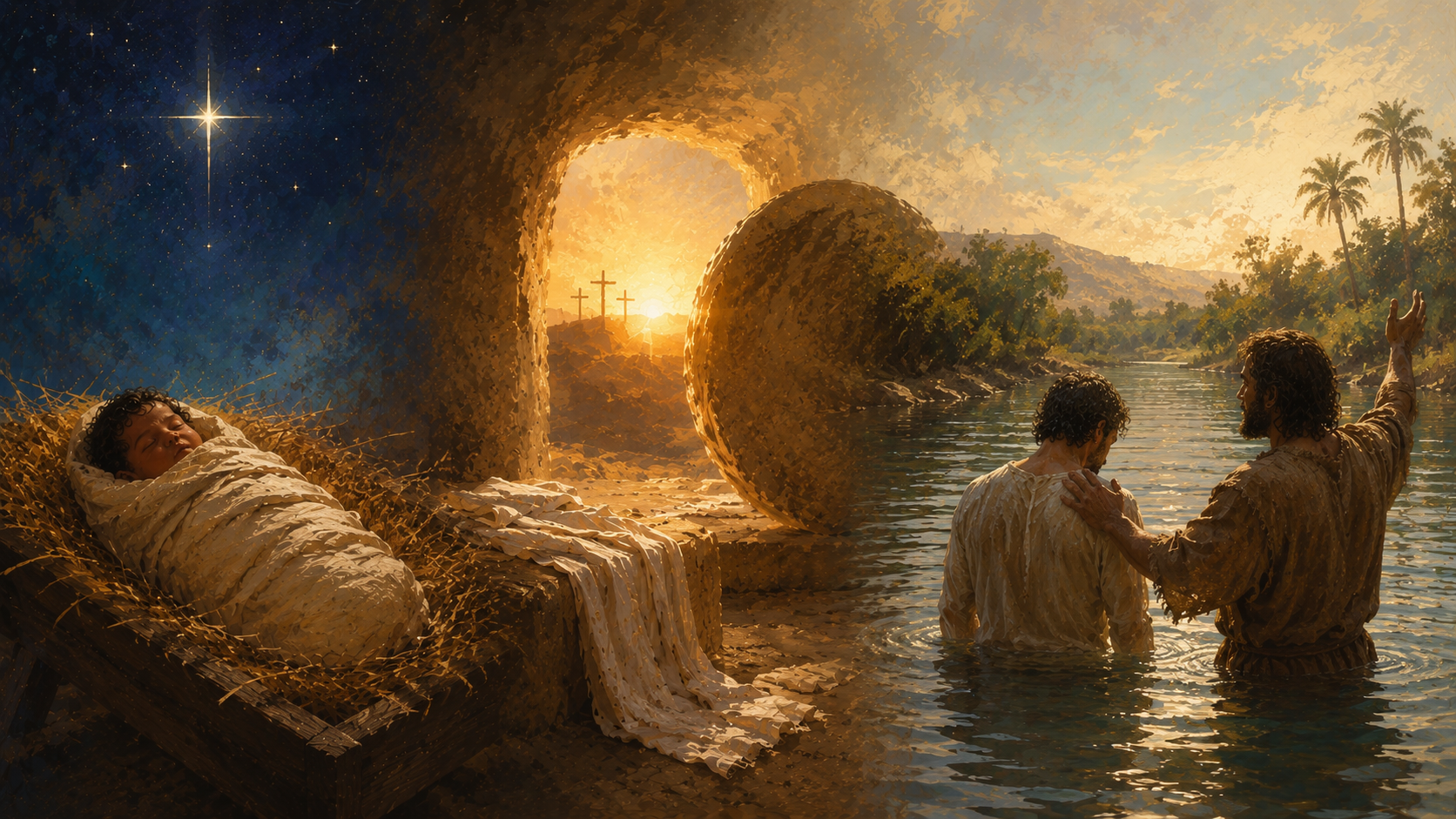
The Bible uses clothing as a window into salvation. From the manger to the empty tomb to the waters of baptism, cloth tells the complete story of what God has done for us in Christ.
A few years ago, I was preaching in Hillsboro, Ohio, when a new congregation started in town. They put up billboards to introduce themselves to the community. If you asked me what message this church wanted residents to know, I would have to say it was this: You can wear jeans to church.
Not God loves you. Not Jesus died for you. You can wear jeans to church.
The funny thing was that the farmers in our congregation already wore jeans to church. We never thought to put that on a billboard.
But now, some twenty years later, I genuinely do care what you wear to church. Before you dismiss that, understand what I mean. We are not talking about denim versus dress clothes. We are talking about something altogether different.
Scripture uses clothing as a recurring image to describe who we are before God and what He has done to change it. There are three moments in the life of Christ where cloth carries enormous theological weight: a stable in Bethlehem, a garden tomb outside Jerusalem, and the waters of baptism. What covers you tells the whole story of who you are.
Jesus Entered the World Wrapped in Swaddling Cloths
Luke records the birth of Jesus with quiet precision: “She gave birth to her firstborn, a son. She wrapped him in cloths and placed him in a manger, because there was no room for them in the inn” (Luke 2:7).
Swaddling cloths were not a symbol of royalty. They were not reserved for kings or priests or the wealthy. Every family in first-century Israel, rich and poor alike, wrapped their newborns the same way. An ancient Jewish writing from around the time of Christ called The Wisdom of Solomon captures the universal nature of this practice. Its author writes that even a king had no different beginning of existence, that there is one entrance into life for all. That text is not Scripture, but it confirms what Luke is showing us: The King of Kings arrived in the same wrapping as a farmer’s son.
The One who spoke the universe into existence arrived unable to speak, unable to walk, unable to feed Himself. He did not come robed in the glory the angels know. Paul describes the weight of that choice in his letter to the Philippians: “Who, being in very nature God, did not consider equality with God something to be grasped, but made himself nothing, taking the very nature of a servant, being made in human likeness” (Philippians 2:6-7).
The angels told the shepherds that the sign would be a baby wrapped in swaddling cloths and lying in a manger. Not a crown. Not a palace. Ordinary cloth and a feeding trough.
You have probably known someone like this. He drives the same truck he has had for fifteen years. You see him at the gas station in a ball cap and a t-shirt, and you would never guess he owns the business or that he has done well enough to retire twice over. He does not lead with what he has. He leads with who he is.
Jesus did the same thing, except on an infinite scale. The One who owned everything arrived owning nothing. He did it on purpose, so that no one would ever have an excuse to say that God does not understand their life. Christ can meet people in their lowliness because He chose to enter it first. The shepherds came in from the fields still smelling like work, and they were welcome.
What covers you tells the whole story of who you are.
When Jesus Left the Burial Linens Behind, He Demonstrated His Divinity
The story does not stay in Bethlehem. It moves to a garden tomb outside Jerusalem, and the cloth found there tells a very different story.
John gives us an eyewitness account of what Peter and John saw when they arrived at the tomb on that first morning: “He saw the strips of linen lying there, as well as the burial cloth that had been around Jesus’ head. The cloth was folded up by itself, separate from the linen” (John 20:6-7).
There was no body. Nothing was in disarray. The linens had not been torn off in a panic. The head cloth was folded and set apart with clear intention. Whatever anyone thought about Jesus before that morning, this moment changes everything. You cannot look at an empty tomb with folded linens and call Him just another man.
Consider the contrast with Lazarus. When Jesus called him out of the tomb in John chapter 11, Lazarus came out still wrapped. Jesus said to those standing nearby, “Take off the grave clothes and let him go” (John 11:44). Lazarus was alive, but he still had the trappings of death hanging on him, and someone else had to remove them.
What happened on Easter morning was something entirely different. Jesus did not need anyone to unwrap Him. He walked out on His own, and the grave clothes stayed exactly where He left them. Lazarus came back to his old life. Jesus opened a door to a completely new one.
The last word Jesus spoke from the cross was not a cry of defeat. “It is finished,” He said (John 19:30). The Greek word translated that way was the same word used to mark a debt that had been paid in full. When Jesus said it, He was declaring that the debt of sin had been settled completely.
If you have ever cleaned out a house after someone passed, maybe a parent or a grandparent, you know what it is like to stand in a room full of things that belonged to a life that is over. The favorite coat. The favorite shoes. Those things meant something once, but the person who wore them has moved on. That is what the tomb looked like on Easter morning. The grave clothes were there, but the One who wore them was not coming back for them. He had moved on to something those linens could never contain.
What covers you tells the whole story of who you are.
When We Are Baptized, We Are Clothed in Christ’s Righteousness
The empty tomb tells us that death has been conquered. But Jesus did not conquer death just for Himself. He conquered it for everyone who would belong to Him. So what does that mean for us? Scripture answers that question with clothing.
Isaiah looked forward to this day with unmistakable joy: “I delight greatly in the Lord; my soul rejoices in my God. For he has clothed me with garments of salvation and arrayed me in a robe of righteousness” (Isaiah 61:10). The prophet Zechariah was given one of the most striking pictures of grace in the entire Old Testament. He saw the high priest Joshua standing before God dressed in filthy clothes, and an angel declared: “Take off his filthy clothes. See, I have taken away your sin, and I will put fine garments on you” (Zechariah 3:3-4). Both prophets are seeing the same truth from different angles. The filthy garments are removed, and clean ones are given in their place. Joshua did not clean himself up first, and neither do we.
Paul makes the connection between baptism and this clothing imagery crystal clear in his letter to the Galatians: “For all of you who were baptized into Christ have clothed yourselves with Christ” (Galatians 3:27). And in Romans he goes even deeper: “We were therefore buried with him through baptism into death in order that, just as Christ was raised from the dead through the glory of the Father, we too may live a new life” (Romans 6:4).
The three moments come together right here. The swaddling cloths mark Jesus coming to earth as one of us. The burial linens left behind mark His conquest of death. The robe of righteousness marks what He gives to everyone who is buried with Him in baptism and raised to walk in newness of life.
The parable of the prodigal son in Luke 15 puts a human face on this. The son demands his inheritance, wastes it, and falls into depravity. On the long walk home, he rehearses his confession, fully expecting to be hired on as a servant. He knows what he is wearing, and he has no illusions about his condition. But his father sees him from a distance and runs to meet him. Before the son can finish his speech, the father calls for the best robe to be brought out and placed on him. The son came home in rags. He left the embrace of his father wearing the robe of a son. The father did not wait for the son to clean himself up first. The robe came before any of that, and it changed everything about how the son was seen from that moment forward.
That is exactly what God does for the person who comes to Him in faith and is baptized into Christ.
A Decision Each of Us Must Make
Jesus entered this world wrapped in swaddling cloths, showing that He fully became one of us. He left the grave clothes behind in an empty tomb, showing that He has fully conquered death. And because of what He has done, God now offers to clothe every believer in the righteousness of Christ.
Every one of us is wearing something. We come before God either covered in our own sin or covered in Christ. Scripture is clear that this covering is not something we earn. It is something God gives.
God is not asking you to clean yourself up first. He is calling you to come to Him in faith, to be buried with Christ in baptism, and to be raised to walk in a new life. The robe of righteousness is not a reward for those who have gotten their lives together. It is a gift placed on the shoulders of those who come to the Father just as they are.
Do not remain draped in what cannot save you. Come to Christ, and be clothed in Him.
The full sermon outline for “Wrapped in Him” is available as a download on Gumroad. All our products have a price listed, they are pay what you wish or download for free. It is formatted for preaching and can be adapted for your congregation or used as a personal study guide.
All Scripture quotations are taken from the Holy Bible, New International Version. Copyright 1984 by Biblica, Inc.