Grace is easy to extend to others. It is much harder to extend to yourself. Most sermons push you toward doing better, being better, praying more, studying more, serving more. This one does not. This one is about what happens when you have already failed, and what Jesus does next.
Earlier this year, my wife Wendi and I went to see The Road to Damascus, a musical focused on the Acts of the Apostles. The program noted that one of its motivations was a question: What happens when you are part of a movement and your leader is no longer there?
That question stayed with me. So I began exploring what the disciples actually did between the time Jesus was arrested and the opening of Acts chapter 1. What I found was not what I expected.
At the end of Matthew 26:56 we read: “Then all the disciples deserted him and fled.”
We tend to focus on what was happening to Jesus during those hours. We rarely stop to think about what was happening to the men who followed him. And what was happening to them matters, because they are not so different from us.
When you feel terrible, thinking you have let God down, give yourself grace, because that is what Jesus would do.
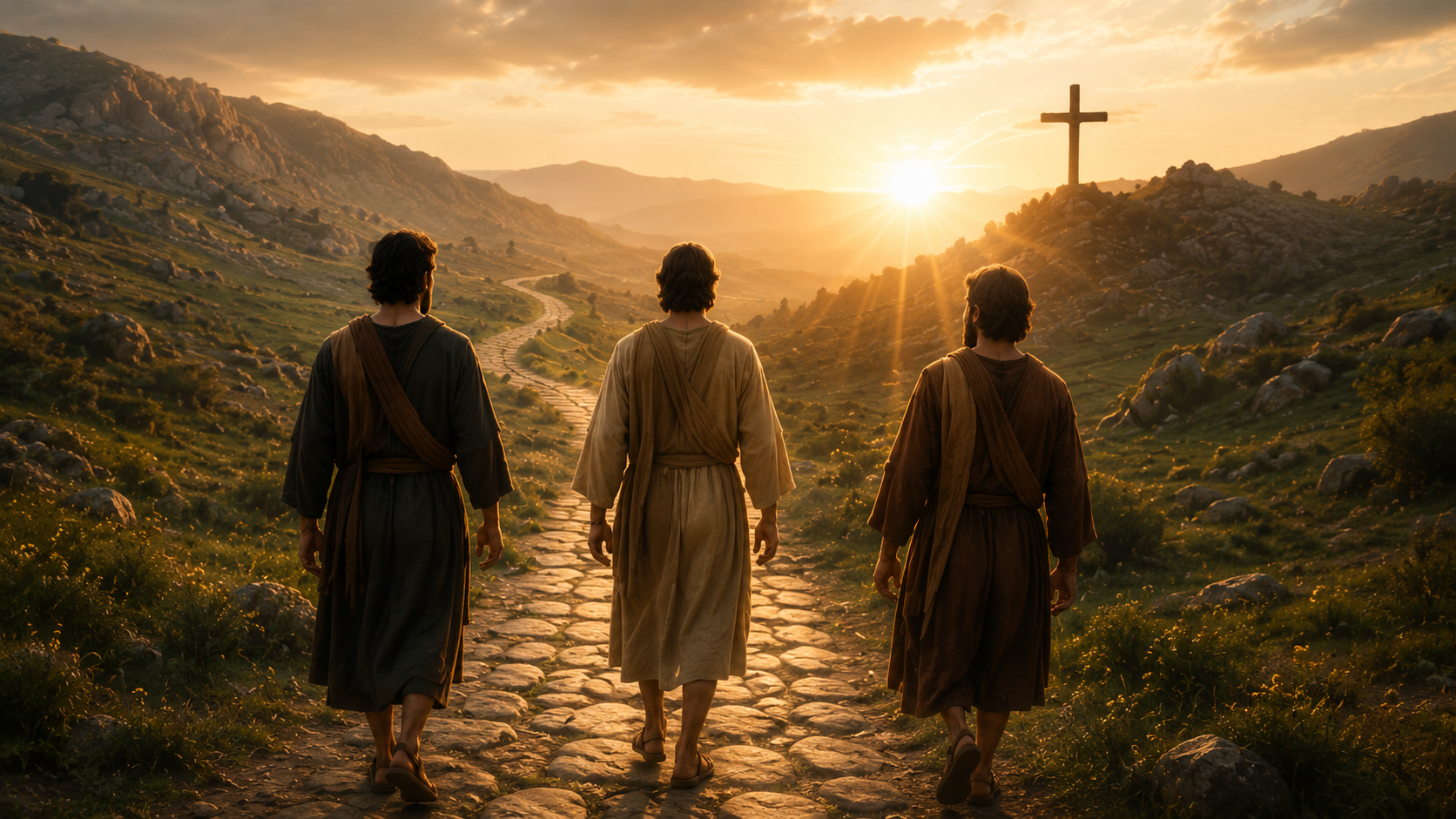
To understand why, we are going to look at three of those disciples and what became of them.
John: When a Fiery Faith Goes Silent
The first time we meet John in Mark’s Gospel, he is with his brother James, preparing nets for a fishing trip. When Jesus calls them, they leave immediately. No hesitation.
In Mark chapter 3, Jesus gives James and John a nickname: Boanerges, which means Sons of Thunder. The name proved accurate. In Luke chapter 9, when a Samaritan village refused to welcome Jesus, the brothers asked, “Lord, do you want us to call fire down from heaven to destroy them?” Jesus rebuked them and moved on. His ministry was one of transformation, not destruction.
There were other incidents. John told Jesus that the disciples had stopped a man from driving out demons in Jesus’ name because he was not part of their group. Jesus corrected him: “Whoever is not against us is for us” (Mark 9:38-40). Then James and John sought positions of power in Jesus’ coming kingdom. Jesus had to redirect them again.
And yet, this is the disciple Jesus loved. John was part of the inner circle, present at the raising of Jairus’s daughter, the Transfiguration, and the Garden of Gethsemane.
But on the night of Jesus’ arrest, the Son of Thunder went completely silent. The man ready to call fire down on a village said nothing when soldiers came for Jesus. He deserted and fled.
That is not the end of John’s story.
Give yourself grace, because that is what Jesus would do.
Thomas: When Doubt Replaces Courage
Thomas is remembered almost universally as Doubting Thomas. But that label flattens a far more complex portrait.
When Jesus announced he was returning to Judea after the death of Lazarus, the disciples were afraid. The people there had already tried to stone Jesus. It was Thomas who stepped forward and said in John 11:16, “Let us also go, that we may die with him.” That is not the language of a man prone to flinching.
Thomas also asked the questions that needed asking. At the Last Supper, when Jesus told the disciples he was going to prepare a place for them, Thomas responded honestly: “Lord, we don’t know where you are going, so how can we know the way?” That question drew one of the most quoted statements in the Gospels: “I am the way and the truth and the life. No one comes to the Father except through me” (John 14:6). The answer exists because Thomas was willing to ask.
Then came the night of the arrest. Like the others, Thomas was silent. He deserted and fled.
After the resurrection, Jesus appeared to the disciples, but Thomas was not with them. When they told him what they had seen, he said in John 20:25, “Unless I see the nail marks in his hands and put my finger where the nails were, and put my hand into his side, I will not believe it.” That is the moment Doubting Thomas was born in the popular imagination, overshadowing everything that came before.
His story does not end there either.
Give yourself grace, because that is what Jesus would do.
Peter: When the Rock Retreats
Peter came into the story through his brother Andrew, who introduced him to Jesus. Jesus gave him a new name: Cephas, or Peter, which means rock.
Peter was part of the inner circle and present at the Transfiguration. It was Peter who gave the Good Confession. When Jesus asked his disciples who they believed him to be, Peter answered in Matthew 16:16, “You are the Christ, the Son of the living God.” Jesus replied that this had been revealed by the Father in heaven, and that on this rock he would build his church, and the gates of Hades would not overcome it.
But almost immediately, things shifted. Jesus began describing his coming death. Peter said, “Never, Lord! This shall never happen to you.” Jesus turned and said, “Get behind me, Satan. You are a stumbling block to me.” The same Peter who had just confessed Jesus as the Christ became, in the next breath, an obstacle to the cross.
At the Last Supper, Jesus told the disciples they would all fall away. Peter insisted he would not. Jesus told him plainly that before the rooster crowed twice that very night, Peter would deny him three times. He did. After Jesus was arrested and taken to the courtyard of the high priest, Peter followed at a distance. Three times he was asked if he knew Jesus. Three times he said he did not. Luke 22:61 tells us that after the third denial, “the Lord turned and looked straight at Peter.” Peter went outside and wept bitterly.
The Rest of the Story
Three men. Three failures. Each deserted Jesus when the pressure became real.
Here is what happened next.
John, who had fled in silence, was present at the crucifixion, standing beside Mary, the mother of Jesus. As Jesus looked out from the cross, he said to Mary, “Dear woman, here is your son,” and to John, “Here is your mother.” At the end of his life, Jesus trusted John with the care of the person he loved most.
Thomas had his moment of reckoning a week after the resurrection. Jesus appeared again, and this time Thomas was there. Jesus said in John 20:27, “Put your finger here; see my hands. Reach out your hand and put it into my side. Stop doubting and believe.” Thomas responded immediately: “My Lord and my God!” The doubt gave way to the clearest confession in the Gospel of John.
Peter was reinstated in John chapter 21. For each of the three denials, Jesus asked Peter once whether he loved him. Peter said he did. After each answer came a charge: Feed my lambs. Take care of my sheep. Feed my sheep. Peter spent the rest of his life doing exactly that.
Give Yourself Grace
John Newton, the former slave trade captain who converted to Christianity and wrote Amazing Grace, once said: “I am not the man I ought to be, I am not the man I wish to be and I am not the man I hope to be, but by the grace of God, I am not the man I used to be.”
That is the grace this post is about.
Were you ever frozen by fear when you could have spoken about Jesus to someone? Give yourself grace, because that is what Jesus did for John.
Have you ever doubted? Give yourself grace, because that is what Jesus did for Thomas, though do not stay there too long.
Have you ever gone silent when you should have stood up for Jesus? Give yourself grace, because that is what Jesus did for Peter.
The only perfect person who ever lived was crucified. We are not perfect, and that is not a surprise to Jesus. He knew what the disciples were made of, and he restored them anyway, trusted them anyway, built his church through them anyway. He will do the same for you.
If Jesus is not yet your savior, that same grace is extended to you. Come to him as you are.
Give yourself grace, because that is what Jesus would do.
The full sermon outline for “Give Yourself Grace” is available as a download on Gumroad. A price is listed, but you can pay what you wish or download it for free. It is formatted for preaching and can be adapted for your congregation or used as a personal study guide.
All Scripture quotations are taken from the Holy Bible, New International Version. Copyright 1984 by Biblica, Inc.