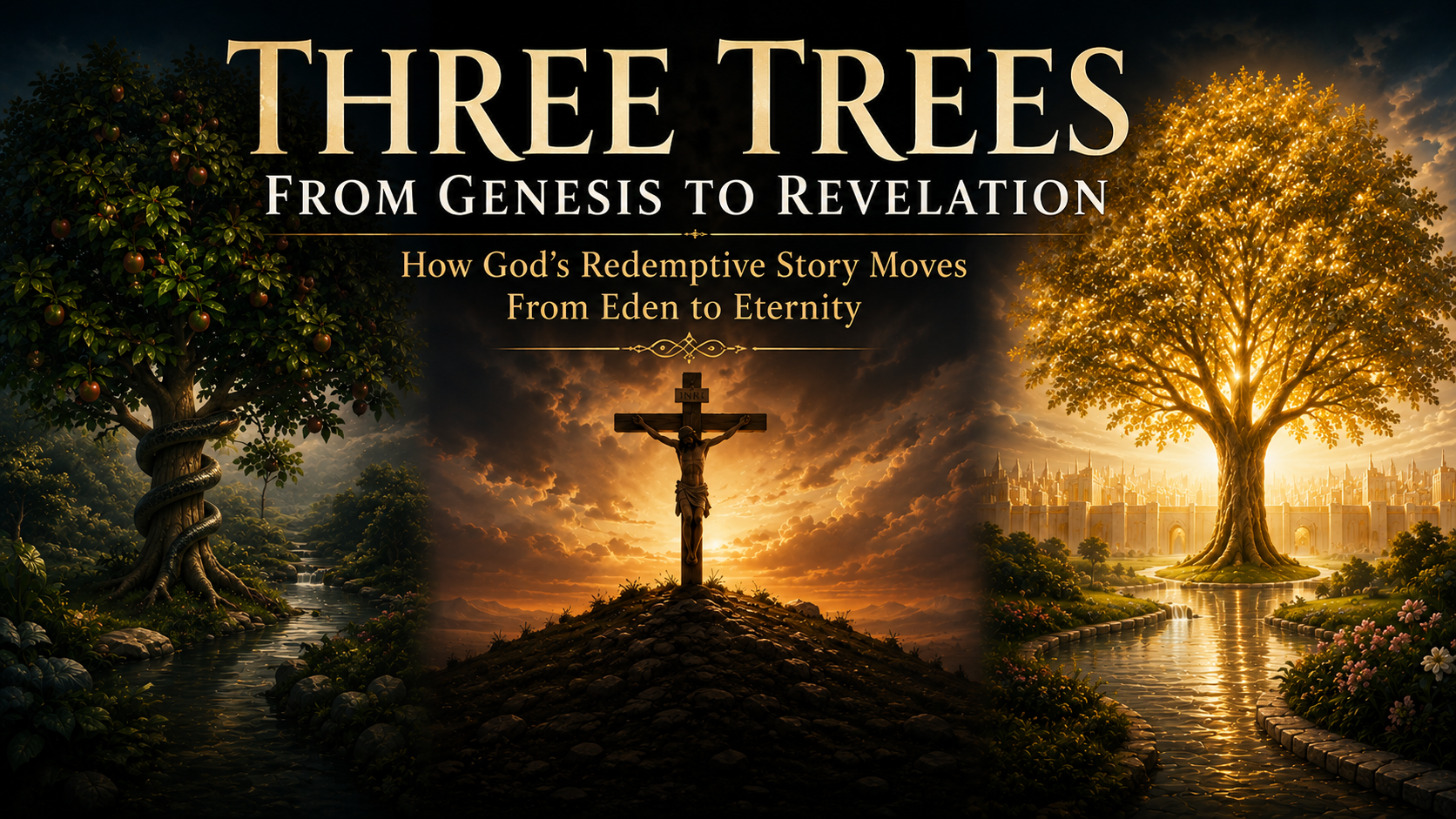
God’s love for humanity is not a vague sentiment, but a plan unfolding since the first garden. Three trees anchor that plan from the opening pages of Genesis to the closing vision of Revelation, and together they tell the story of a God who has never stopped working to bring His people home.
The Tree That Revealed Our Rebellion
In 1995, Alan Jackson re-recorded a song written by Roger Miller and George Jones called “Tall, Tall Trees.” In it, he sings like a man who is head over heels for a woman, promising his sweetheart just about anything she could ever dream of. He keeps saying he will buy her “tall, tall trees and all the water in the seas,” because he is, in his own words, a fool for her. It is a fun, lighthearted song, and it reflects a very human longing: the desire to love someone so completely that you would give them everything. But even the best human love has limits, and that is what makes the story of God’s love so different.
At the center of the Garden of Eden stood two trees. God gave Adam access to everything in the garden, with one exception: “You are free to eat from any tree in the garden; but you must not eat from the tree of the knowledge of good and evil, for when you eat of it you will surely die” (Genesis 2:16-17). That boundary was not a prison. It was a gift that made love, trust, and obedience possible.
Biblical scholar Dr. Nathan French argues that “the knowledge of good and evil” refers to divine judicial wisdom, the authority to discern, judge, and govern the world as God does. Adam and Eve were not simply taking forbidden fruit. They were seizing at the right to define good and evil for themselves. In reaching for the fruit, they reached for the throne.
When the serpent approached Eve, his first move was not to place fruit in her hand but to plant suspicion in her heart. “Did God really say, ‘You must not eat from any tree in the garden’?” (Genesis 3:1). Once a person believes God is withholding something good, disobedience soon begins to look reasonable.
Have you ever driven down a dark country road late at night where there are no streetlights and the only thing guiding you is those reflective stripes painted right down the middle and along the edges? When Wendi and I lived in Cincinnati and drove to Hillsboro where I was preaching, we had to drive through Brown County. The reflective paint had faded, and it became difficult to tell where the center of the road was or where the edge was, making the drive home at night dangerous. God’s commands are those reflective lines that never get dull. They are there to keep you on the straight and narrow, not to prohibit your movement, but to protect you when you do move.
Even after sin entered the world, God’s mercy remained. “The Lord God made garments of skin for Adam and his wife and clothed them” (Genesis 3:21). Their fig leaves could not answer for their shame, so God provided what they could not provide for themselves. The garments of skin introduce a pattern that runs through the whole Bible: sin brings shame, sinners cannot cover themselves, and God must provide the covering. That pattern finds its fullness in Christ.
The story that began with a tree in a garden ends with a tree in a city.
The Tree That Promises Restoration
Adam and Eve were driven from Eden, cut off from the Tree of Life, the way back guarded by cherubim and a flaming sword. God blocked that access not merely as punishment but to prevent something far worse than physical death: an endless existence in a sinful and cursed condition with no hope of redemption. Even in judgment, God was acting in mercy.
But the Tree of Life does not disappear from the story. It reappears at the very end.
“Then the angel showed me the river of the water of life, as clear as crystal, flowing from the throne of God and of the Lamb down the middle of the great street of the city. On each side of the river stood the tree of life, bearing twelve crops of fruit, yielding its fruit every month. And the leaves of the tree are for the healing of the nations” (Revelation 22:1-2).
This is exactly the life Jesus said He came to give: “I have come that they may have life, and have it to the full” (John 10:10). “Blessed are those who wash their robes, that they may have the right to the tree of life and may go through the gates into the city” (Revelation 22:14). The right to the tree is not earned by merit but granted through cleansing in Christ. It leads to a city where God Himself promises: “He will wipe every tear from their eyes. There will be no more death or mourning or crying or pain, for the old order of things has passed away” (Revelation 21:4). Heaven is the place where God is, and that makes it everything.
The story that began with a tree in a garden ends with a tree in a city.
The Tree That Opens the Way
The way to the Tree of Life in Revelation runs straight through a third tree, one every follower of Jesus already knows.
The cross is not merely a Roman execution. It is part of God’s unbroken redemptive story. “The God of our fathers raised Jesus from the dead, whom you had killed by hanging him on a tree” (Acts 5:30). The language of “tree” ties Calvary back to Eden and forward to the Tree of Life. The cross does not merely cover our sin the way fig leaves covered Adam and Eve. It removes sin entirely. “He himself bore our sins in his body on the tree, so that we might die to sins and live for righteousness; by his wounds you have been healed” (1 Peter 2:24). The clearest proof that God’s love is unconditional: “While we were still sinners, Christ died for us” (Romans 5:8).
What looked like the most cursed death imaginable became the moment God turned the curse into redemption. “Christ redeemed us from the curse of the law by becoming a curse for us, for it is written: ‘Cursed is everyone who is hung on a tree'” (Galatians 3:13). Jesus stepped into the place of the curse so that we could step into the place of blessing. When He cried out “It is finished,” the debt of sin that Adam and Eve could never repay was paid in full.
Do you remember the story of Moses in the wilderness, when venomous serpents were biting the Israelites and people were dying? God told Moses to lift up a bronze serpent on a pole, and anyone who looked at it would live. Centuries later, Jesus said, “Just as Moses lifted up the snake in the wilderness, so the Son of Man must be lifted up.” In the same way, the cross is the means God chose to bring us back to the Tree of Life. All who look to the One lifted up on that tree will find the life they were always meant to have.
The story that began with a tree in a garden ends with a tree in a city.
A Decision Each of Us Must Make
For those who have walked with Christ for many years, this is a message to strengthen hope. There are days when prayers seem unanswered and losses leave deep wounds. But because of what Christ has done, a day is coming when everything sin has broken will be restored.
And if you have never trusted Christ, the message is personal. Humanity’s story began with exile. Adam and Eve were driven from the garden, and ever since then the human race has lived east of Eden. But God did not leave the gate closed forever. The cross became the place where God opened the way home. The God who once drove humanity from the garden is the same God who, through Jesus Christ, is bringing His people home.
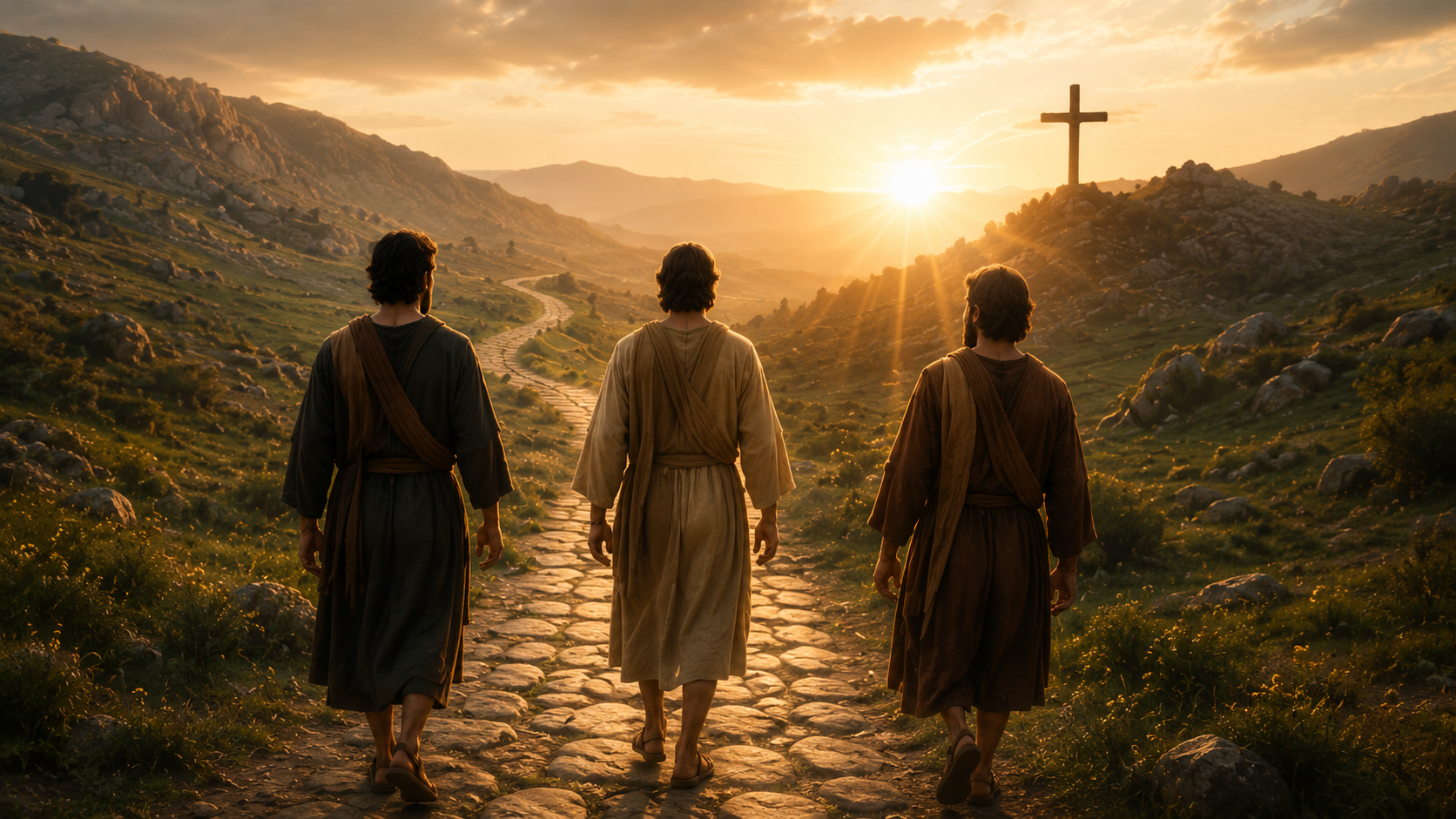
Where are you in this story? Are you still living in exile, or are you walking the road that leads back to the Tree of Life? The invitation is open. It is time to come home.
The full sermon outline for “Three Trees: From Genesis to Revelation” is available as a download on Gumroad. Pay what you wish or download for free. It is formatted for preaching and can be adapted for your congregation or used as a personal study guide.
All Scripture quotations are taken from the Holy Bible, New International Version, NIV. Copyright 1984 by Biblica, Inc.